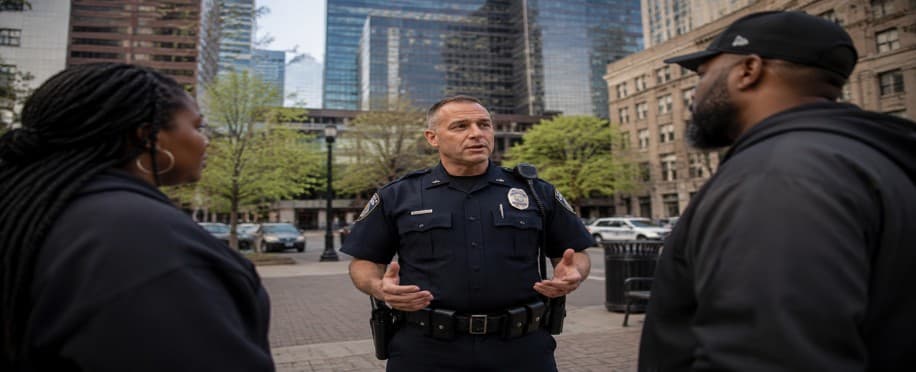
People's involvement in community safety is one of the best law enforcement strategies. This approach is commonly known as community policing, where police officers and residents collaborate to enhance safety and prevent crime.
The popular challenges of community policing are community engagement and trust in police officers and the entire system. This is highly critical in communities with previous difficult situations and harsh law enforcement plans.
Continue reading this article to learn all about community policing, why it is important, challenges, included elements, police objectives from this enforcement, and tips to overcome complex challenges.
Community policing is a law enforcement strategy that develops efficient partnerships between police officers and local community members, whether residents or people working in the area. This aims to identify and solve problems, establish trust, boost collaboration, and implement proactive crime prevention. This helps create stronger relationships between the community and police, and safer neighborhoods over time.
Community policing matters because it builds up trust between residents and law enforcement, encourages collaboration, and improves problem-solving. This helps police officers address the root causes of incidents and community concerns, and they can effectively reduce criminal activity, focus on justice, enhance public safety, and create more responsive police practices.
What Are the Main Challenges of Community Policing?
The main challenges of community policing are attached to the police department itself and to community acceptance. The main challenges are:
- Institutional resistance.
- Limited resources and staffing.
- Community distrust and uncertainty.
- The time required to build sustainable trust.
- Difficulty measuring success with clear KPIS.
- Institutional Resistance:
Some police officers and leaders may resist organizational changes, making it difficult to adopt community-focused strategies and practices consistently.
- Limited Resources and Staffing:
Community policing strategies require a higher budget, updated safety training, and more executive staffing, so they can follow up as needed and prioritize.
- Community Distrust and Uncertainty:
Past negative experiences or lack of real communication may be challenging and create skepticism, making communities hesitant to collaborate or trust police agencies in the approach implementation.
- The Time Required to Build Sustainable Trust:
Developing a valuable relationship with the community requires consistent interaction with police officers and long-term commitment, which could be a time-consuming strategy.
- Difficulty Measuring Success with Clear KPIs:
Some community-oriented policing outcomes can be difficult to measure on paper because trust and perceptions are not easily measured.
Effective community policing means addressing the 4 elements of its implementation:
Police collaborate with residents, businesses’ chief operating officers, schools, and organizations to address concerns and respond effectively.
With direct community interactions, officers can identify challenging and underlying causes of repeated issues and complex incidents, and develop targeted approaches instead of responding to accidents.
- Organizational Transformation:
Police departments and agencies adjust policies, executive structures, and culture to support community engagement and collaborative approaches effectively.
- Prevention and Proactivity:
Community policing highlights preventing crime before it occurs through education, outreach, and proactive intervention strategies.