China is Catching up to the US in Brain Technology, Competing with Firms Like Elon Musk's Neuralink
China is Catching up to the US in Brain Technology, Competing with Firms Like Elon Musk's Neuralink

23/07/2025
A 67-year-old woman with amyotrophic lateral sclerosis (ALS), also known as Lou Gehrig's Disease, created a computer message in Chinese characters at a Beijing public hospital, expressing her desire to eat.
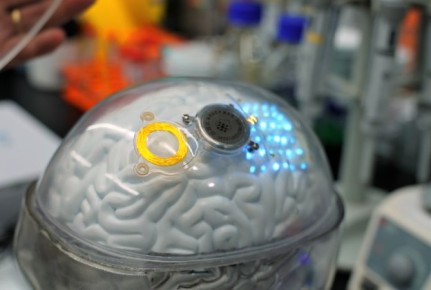
Notably, a clinical trial in Beijing involved five patients implanted with a coin-sized chip called Beinao-1, a wireless brain computer interface (BCI), a technology led by US scientists, which experts believe China is quickly catching up to.
The Vitality of BCI Technologies
The Chinese Institute for Brain Research (CIBR) director, Luo Minmin, has expressed a strong need for BCI technology, stating they have been overwhelmed by patient requests.
Luo's team plans to expedite human trials by implanting chips into 50 to 100 more patients over the next year, as the technology is demonstrating high accuracy in decoding brain signals and translating them into text or machine movements.
Moreover, Beinao-1 has implanted five patients, similar to Elon Musk's Neuralink, while Synchron, a US company with investors like Jeff Bezos and Bill Gates, has tested 10 patients in the US and Australia.
Remarkably, the neuroscience professor, Maximilian Riesenhuber, at Georgetown University, praised China's progress in the Beinao trials, stating that despite starting later than the US, China has shown the ability to catch up and drive the field in some areas, leading to increased research activities in both countries.
The brain technology market, worth $2.6 billion, is predicted to reach $12.4 billion by 2034. The market's significance lies in China and the US, with Chinese leader Xi Jinping's global ambitions causing concern in the US, particularly in the semiconductor industry.
A Novel Strategy
CIBR, founded in 2018, was established by Beijing's municipal government and local universities. In 2023, it incubated NeuCyber NeuroTech, a private company focusing on brain tech products like Beinao-1.
Additionally, a 60-year-old ALS patient has been able to speak simple sentences accurately after undergoing a brain-computer interface (BCI) implantation. The scientist, who received his PhD in neuroscience from the University of Pennsylvania, emphasises the importance of balancing risk and effectiveness in BCI research.
American firms often use invasive methods to place chips inside the dura mater, an outer layer of brain and spinal cord tissue, to capture a better signal, but these require riskier surgeries.
The Beinao-1 chip has completed its third human trial, marking the world's first batch of semi-invasive implantation of wireless BCI in human brains. As of May, two more trials have been conducted, totalling five.
A Definite Goal
US and Chinese tech breakthroughs are regularly compared due to rising geopolitical tensions. Brain-computer interface technology began in the 1970s in the US, and the Obama Administration invested over $3 billion in neuroscience technology projects since 2013.
Besides, Synchron, a New York-based firm, began human trials in 2021. Three years later, UC Davis Health developed a 97% accuracy BCI system for ALS patients, and Musk's company completed its first human trial.
China, a pioneer in brain technology since the 1990s, is rapidly advancing, with a national project in 2014 and ethical guidelines issued by the government. Local governments support brain technology companies from research to commercialisation. Georgetown University researchers published research in 2024 comparing China's progress to the US and the UK.
In short, Luo, a brain tech expert, argues that the US is the leader in invasive and non-invasive brain technology. He compares Beinao-1 and Neuralink, noting differences in implant location, brain signal type, and data transmission method.
Read more news:
Elon Musk claims that a "massive cyberattack" caused waves of outages on his X
TikTok 'Craze' Caused Peak District's Severe Parking Situation
Microsoft will shut down Skype in May after nearly two decades