Strategies for Corrosion Control in Oil and Gas Industry
Corrosion remains one of the most significant threats to safety, reliability, and profitability in the oil and gas industry. By implementing effective corrosion control strategies—including protective coatings, chemical inhibitors, cathodic protection, and proactive inspection programs—organizations can extend asset life, reduce operational risks, and improve long-term performance.
14/06/2026
Oil and Gas
Corrosion control in the oil and gas industry is the planned use of materials, coatings, chemical treatment, inspection, and maintenance to reduce metal degradation in wells, tanks, processing units, and pipelines. It protects production continuity, improves safety, lowers repair cost, and extends the service life of critical energy infrastructure.
In this article, you will learn what causes corrosion, which prevention methods work best, and how operators can build a practical programme that supports safer, more efficient asset management.
Why Corrosion Control Matters
Corrosion is a serious operational risk in the oil and gas industry because equipment is exposed to water, salts, carbon dioxide, hydrogen sulphide, oxygen, heat, pressure, and abrasive solids. These conditions can weaken steel, reduce efficiency, and turn a small defect into a major failure.
The business impact is direct. Corrosion can stop production, increase maintenance budgets, damage hydrocarbons containment, delay delivery, and create environmental exposure. For this reason, corrosion control in the oil and gas industry is not only an engineering function; it is part of long-term operational protection.
Companies that manage corrosion early make better decisions on design, procurement, inspection, and lifecycle planning. They also reduce emergency work, improve asset performance, and support stronger leadership decisions in complex operating environments.
Main Corrosion Causes in Oil and Gas Assets
Oil and gas assets face several corrosion mechanisms depending on fluid chemistry, temperature, pressure, and operating conditions. A well, tank, platform, refinery unit, and pipeline can each fail in a different way.
The most common causes include:
- Carbon dioxide in produced water
- Hydrogen sulphide in sour service
- Oxygen contamination in water handling systems
- Chlorides in marine or produced fluids
- Bacteria in stagnant water systems
- Sand or solids in fast-moving flow
- Poor coating application or damage
- Weak inspection discipline
A comprehensive review should identify the cause before selecting a solution. Treating all corrosion in the same way often leads to wasted spending and incomplete protection.
Corrosion Control in Oil and Gas Pipelines
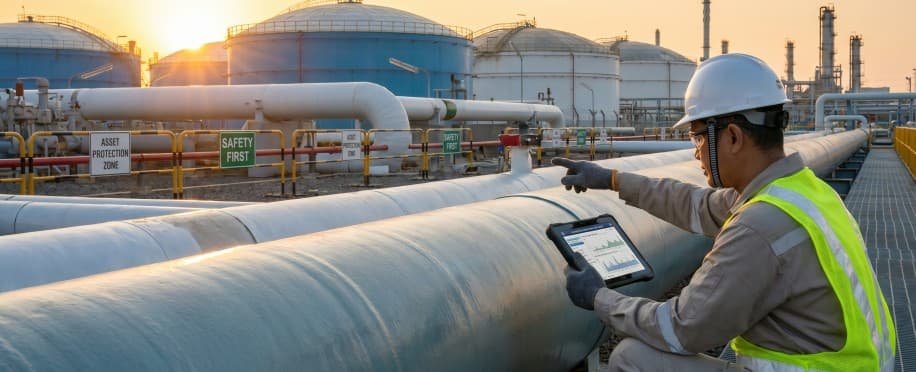
Corrosion control in oil and gas pipelines starts with design. Engineers should review route conditions, soil chemistry, water content, flow velocity, operating temperature, pressure, steel grade, and access for inspection.
External protection usually depends on coatings and cathodic protection. The coating separates metal from soil or seawater, while cathodic systems reduce electrochemical attack where the coating has defects.
Internal damage is different. Produced water, CO₂, H₂S, sand, bacteria, and deposits can attack the pipe from inside. Operators often use inhibitors, cleaning pigs, biocides, ultrasonic testing, monitoring probes, and inline inspection tools to detect damage before failure.
Risk ranking is also important. High-consequence areas, ageing assets, wet gas service, and offshore risers need closer attention because failure can affect safety, production, and the surrounding environment.