Trump Raised Import Duties on the US & is Now Considering Exports, Raising Concerns about 'Dangerous Precedent'
Trump Raised Import Duties on the US & is Now Considering Exports, Raising Concerns about 'Dangerous Precedent'
20/08/2025
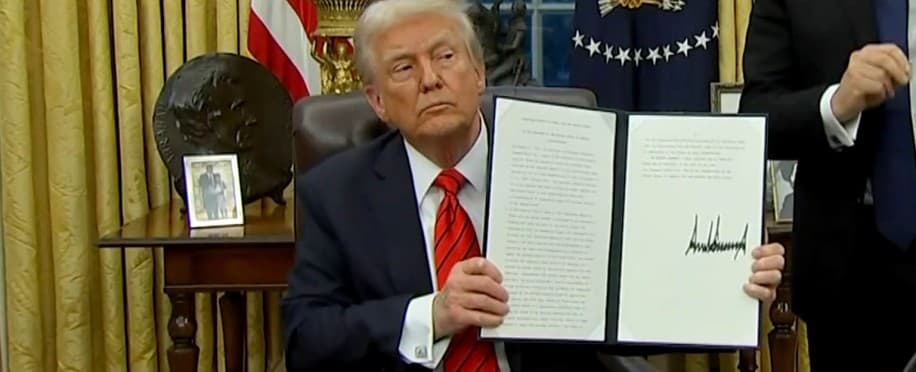
Apple CEO Tim Cook presented a unique gift to the White House, a box made in California, containing an engraved glass plaque and a slab for the plaque, with a base made in Utah and 24-karat gold. Cook reassured his audience in the Oval Office.
Notably, Donald Trump was genuinely moved by Apple's gift, while the company also announced an additional $100bn investment in US manufacturing.
Trade & Technology's Intersection
President Trump declared Apple to be among the businesses immune from a new US tariff on imported computer chips. This move highlights the Art of the Deal in the White House, where Trump is brokering agreements with tech companies, much like to his real estate transactions.
In recent days, this dealmaking has ventured into uncharted territory.
Following a meeting between Nvidia CEO Jensen Huang and Trump, the US government has granted Nvidia and AMD permission to sell certain AI chips to Chinese companies, provided they share 15% of their revenue with the US government.
Moreover, Trump's dramatic change in halting chips' exports has prompted speculation that Nvidia is buying its way out of tensions between Washington and Beijing. Trade experts warn that such a deal could destabilise trading relations and create the perception that export controls are up for sale.
The White House announced a revenue-sharing agreement with China, but it has not been rolled out due to legal complications. Critics argue it could be a tax on exports, potentially unconstitutional under US laws. The Department of Commerce is still determining the deal's legality.
Likewise, Nvidia and AMD are at the centre of the US-China technological arms race, with Nvidia producing essential AI processing chips. The US government regulates AI chips and manufacturing equipment for China, aiming to slow its AI development if it has less computing power. This gives the US a clear advantage in the arms race.
Despite US restrictions, China has been gaining ground, raising concerns about the direction of US policy.

Managing Security & Innovation
Nvidia and AMD have agreed to sell AI chips to China, which are not high-end and not powerful enough for training new models. Trump referred to these chips as “old chips that China already possesses” under a different label.
This raises a debate on AI policy, with some arguing that allowing Chinese companies to purchase such chips could help China gain an advantage, while others argue it would be counterproductive.
The Trump administration is requesting companies to pay for exporting to China, a solution that is seen as precarious by both sides of the AI debate.
Besides, US Treasury Secretary Scott Bessent has praised the deal with China, stating it could be extended to other industries over time. However, Republican US representative John Moolenaar argued that export controls are crucial for national security and should not incentivise the government to sell China technology that enhances AI capabilities.
Julia Powles, executive director of the Institute for Technology, Law, and Policy at the University of California, Los Angeles, questions if similar pressure can be applied to other tech companies.
Ultimately, Trump stated in a press conference that he requested 20% for approval of a deal with Huang, indicating that this is the current White House approach, a deal for the country.
Read more news:
- China is Catching up to the US in Brain Technology, Competing with Firms Like Elon Musk's Neuralink
- London Premier Centre Forms a Landmark Partnership with The KPI Institute to Advance KPI Capability
- New Grok AI Model Surprises Experts by Checking Elon Musk's Views Before Responding