What you need to know about operational risk management 2022
What you need to know about operational risk management 2022

24/07/2022
Management & Leadership
Operational risk management can be classified within the company's overall management, where it exists to manage certain corporate risks, including barriers to success.
Plans to move away from these risks need to be developed through solid risk management. How can we work to stay in safety? What axes of a company's operational risk management reduce the likelihood of losses? That's what we'll know in our article.
What is Operating Risk Management?
Operational risk management includes the management of any problem that is considered to harm an organisation's business operations. Operational risks are linked to several causes, which cause financial losses, the non-expansion of organisations, weak progress and achievement of their objectives.
Operational risks gradually accumulate, as problems and errors have been ignored from the outset, whatever their size or impact, and thus exacerbated into risks that expose institutional work to inevitable failure.
Operational risk management is one of the organisational risk management functions, which takes away strategic and reputational risks and institutional problems, but what are the most significant risks facing organisations?
Main Operational Risks in Companies
naturally; Internal or external problems must arise in any company, but there are real risks to which the company may be exposed, including:
- Risk of cyberattacks to hack private company information.
- Legal risks: are non-compliance with laws or controls established, such as non-compliance with internal and external laws, which exposes the company to operational risks.
- Employee errors: Employees cause either the company's success or failure; The company may face risks due to one of its employees, as it may fail to be able to retain or manage the company's resources, which opens the door to human errors, and allows some people to commit fraud.
- External environmental risks: activities or factors occurring outside the company, such as natural disasters or political or economic instability.
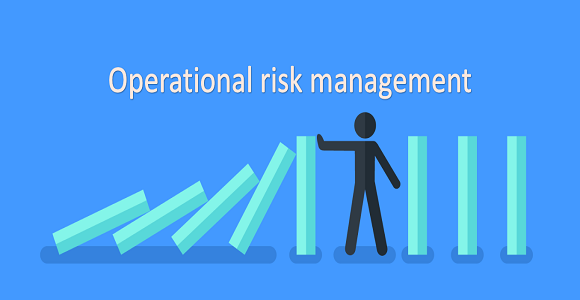
Operational risk management steps:
Operational risk management's work aims to reduce these risks. Management work includes the application of five key steps, namely, best practices adopted at the level of operational risk management:
1. Identifying risks
Risk identification and management are made by knowing the impediments to achieving the goals. Thus, the more goals are understood, the easier the process of identifying the constraints and risks of the company.
2. Risk assessment
The risk assessment process involves classifying these risks in terms of their probability and measuring their impact.
3. Risk Reduction
it is a systematic process that identifies specific ways of mitigating risks, placing them within the safety framework. And four ways to mitigate can be followed, but each has a different approach: avoidance, diversion, control and acceptance.
4. Control of implementation.
Implementation is to mitigate the risks facing organisations, and controls are implemented here, where censorship is seriously activated, and controls are implemented by whoever causes mistakes.
5. Monitoring
When implementing controls, it is better to monitor them, especially since those who execute them cause errors, and control includes testing it in terms of implementation, design and operational effectiveness.
Some organisations develop a surveillance system that reveals any risk prematurely or before increasing, which has given way to address any problems or risks to the institutions.
Operational risk management challenges
Some organisations suffer from the problem of managing operational risks, which may be a weakness for the organisation. Therefore, there must be a director in the company who has to lead in a crisis. These challenges include many problems that may weaken the organisation's solution, including:
- The company's false picture is that it cannot have an ERM requirement.
- Weak risk measurement methodology.
- Insufficient awareness about operational risks and what might lead to the company.
- The complexity of the management process is due to changes in technology.

Benefits of creating an operational risk management program:
Establishing a specialised operational risk management program is essential in eliminating risks as much as possible, which helps to achieve the company's objectives and helps to continue to operate, even with problems.
The Operational Risk Management program will help with systematic management and paint a picture for consumers that the organisation continues to operate under any circumstances.
It benefits the company's name, improves the spread of the brand, expands relationships with customers, earns their trust in the company, and adds more ongoing financial forecasts.
When developing an operational risk management programme, emphasis should be placed on some points, such as exploiting the development of technology to proceed in a programmed manner in collecting risk information. Identifying and evaluating risks by establishing standard terminology for measurement methodology is essential for placing it within the programme and developing risk solutions.
Operational risk management is vital in managing an enterprise, but if a company can't find a solution to risk, how will it continue to work?!
It is worth mentioning that following short courses in management and leadership will benefit each company manager seeking to solve various problems and risks.