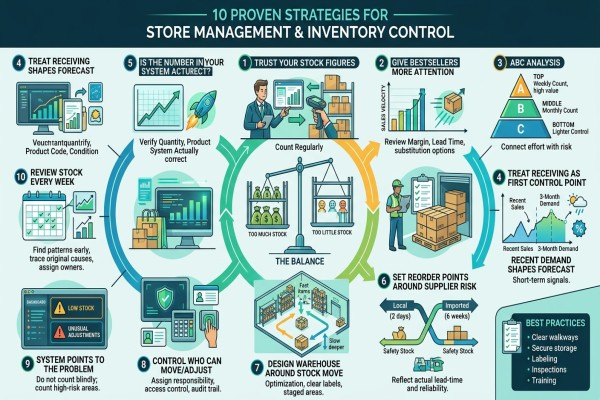
4. Treat Receiving as Your First Real Control Point
Many inventory problems begin before products ever reach the shelf. That is why the inventory receiving process deserves more attention than it often gets.
Imagine receiving 100 units while someone accidentally records 110. The system now shows ten units that do not exist. Weeks later, that gap may look like shrinkage, theft, or a picking error, even though the mistake happened at the door.
Store Management and Stock Control works better when receiving teams verify quantity, product code, condition, and purchase-order details before goods enter the system. Clear notes and documented exceptions also make later investigations far easier.
If your team needs a more structured approach, effective store management and stock control training can help connect receiving, coding, record keeping, and stock control procedures into one practical process.
5. Let Recent Demand Shape the Forecast
Historical sales matter, but they do not always tell you what happens next. Promotions, weather, events, competitor activity, and changing customer preferences can all shift demand quickly.
So, instead of relying only on last year’s average, ask what customers are doing now.
That approach is supported by the 2025 study A Machine Learning Approach to Inventory Stockout Prediction. Researchers analysed more than 1.6 million SKUs and found that current inventory, recent sales, and three-month demand forecasts were among the strongest predictors of stockouts.
For Store Management and Stock Control, the practical lesson is simple: short-term signals deserve attention, especially around peak periods or promotions. A forecast should move with the market rather than sit unchanged in a spreadsheet.
6. Set Reorder Points Around Real Supplier Risk
Forecasting becomes useful only when it changes replenishment. This is where reorder points matter.
A good reorder point considers how much you expect to sell while replacement stock is on the way. Then you add safety stock where uncertainty justifies it. However, the same rule should not apply to every product.
A locally supplied item with a two-day lead time needs a different buffer from an imported product that takes six weeks to arrive. Store Management and Stock Control becomes stronger when reorder settings reflect actual lead-time risk, supplier reliability, and the cost of a stockout.
That also helps you avoid a common reaction: holding too much inventory simply because nobody trusts the replenishment process.
7. Design the Warehouse Around How Stock Moves
A warehouse should make daily work easier. If employees spend too much time walking, searching, or moving around unnecessary obstacles, the layout is working against them.
Warehouse optimization starts with flow. Fast-moving items should sit closer to picking or dispatch areas, while slower products can use less accessible locations. Receiving, storage, picking, and dispatch should also follow a logical sequence.
For Store Management and Stock Control, this matters because every unnecessary movement adds labour time and another opportunity for error or damage. Clear labels, fixed locations, and defined staging areas make the operation easier to understand at a glance.
| Area to review | What it may reveal | Practical response |
| Inventory accuracy | Physical and system stock do not match | Investigate repeated differences |
| Stock availability | Frequent stockouts | Review forecasting and reorder points |
| Receiving | Repeated quantity errors | Tighten receiving checks |
| Product movement | Slow turnover | Adjust purchasing levels |
| Security | Unexplained adjustments | Review access and authorization |
8. Control Who Can Move or Adjust Stock
Good warehouse security is not only about locks and cameras. You also need to know who can move stock, change quantities, approve write-offs, or enter restricted areas.
Why? Because inventory losses are not always caused by theft. An unrecorded transfer, damaged goods, uncontrolled returns, or a careless system adjustment can create the same discrepancy.
Warehouse security & access control therefore supports Store Management and Stock Control by making responsibility visible. Coding, scanning, access permissions, and approval rules create an audit trail that helps you understand what happened when figures do not match.
For managers developing broader operational skills, professional training opportunities in Dubai can support wider management and administration capability.
9. Make Your Inventory System Point to the Problem
Inventory management systems should do more than store numbers. They should help you notice where attention is needed.
A useful system can flag low stock, unusual adjustments, delayed receipts, sudden changes in demand, or products that have stopped moving. That gives you a chance to investigate early instead of discovering the issue during an annual count.
Research supports this targeted approach. The study Evaluating Count Prioritization Procedures for Improving Inventory Accuracy in Retail Stores found that strong prioritization methods detected more than twice as many discrepancies as random counting, while the best low-stock rule identified more than eight times as many unknown stockouts.
For Store Management and Stock Control, the message is useful: do not count blindly. Count where the risk of error or lost sales is highest.
10. Review Stock Every Week, Not Only at Year-End
Annual counts are important, but they are not enough to manage day-to-day inventory. If you discover a discrepancy six months after it happened, tracing the original cause can be difficult.
A short weekly review gives you a much better chance of catching the pattern early. Look at stockouts, slow-moving products, supplier delays, receiving discrepancies, unexplained adjustments, and customer complaints about availability.
Most importantly, give each recurring problem an owner. Store Management and Stock Control improves when someone is responsible for asking what caused the issue, what should change, and whether the correction actually worked.
This is where control becomes part of everyday management rather than a once-a-year exercise.
Best Practices for Effective Warehouse Maintenance and Management
When a warehouse becomes cluttered, poorly organised, or difficult to navigate, small issues can quickly turn into damaged stock, delayed orders, and avoidable safety risks. Keep your warehouse safe, organised, and efficient by following these practical steps:
- Keep walkways, exits, and emergency equipment clear at all times.
- Store products securely and place heavier items on lower shelves.
- Label shelves, storage areas, and inventory clearly.
- Carry out regular inspections to identify hazards, damage, or blocked access.
- Train employees on safe lifting, equipment use, and emergency procedures.
- Use suitable storage systems to make stock easier to find and move.
- Review your layout regularly to improve workflow and reduce unnecessary movement.
Conclusion
Strong Store Management and Stock Control is not built around one perfect system or one stock-counting method. It comes from connecting accurate records, sensible priorities, disciplined receiving, responsive forecasting, realistic reorder points, warehouse flow, security, and regular review.
When those elements work together, you gain much more than tidy shelves. You protect sales, reduce avoidable costs, release cash tied up in excess inventory, and give customers more reliable service. Most importantly, Store Management and Stock Control gives you clearer answers to the questions every manager needs to ask: what do we have, what is moving, what is at risk, and what should we do next?