Top Benefits of Professional Facilities Management
Poorly managed facilities cost more than most organizations realize. Unplanned maintenance, energy inefficiency, compliance failures, and low staff productivity are all symptoms of the same underlying problem: a lack of structured facilities management. The benefits of facilities management are measurable, well-documented, and directly tied to how well a business controls its costs, protects its people, and maintains its assets. In this article you will read a clear, evidence-based breakdown of the top benefits — from operational efficiency and safety compliance to software integration and outsourcing strategy — giving business leaders and FM professionals the insight they need to make informed investment decisions.
29/05/2026
Facilities Management
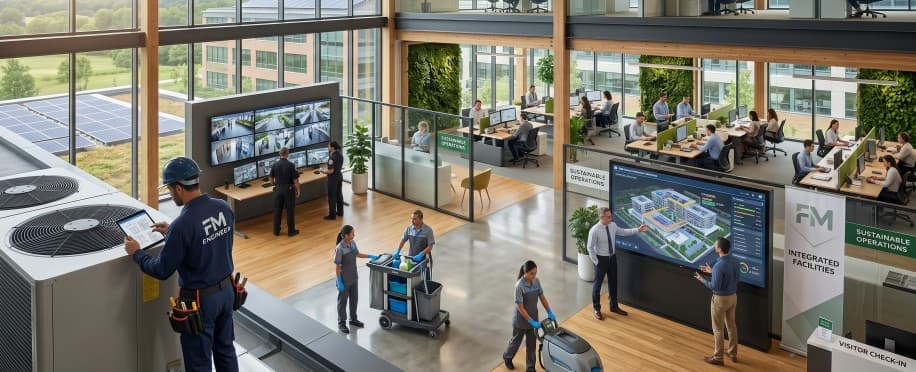
Professional facilities management is the coordinated practice of overseeing a building's physical environment, infrastructure, and support services to ensure safe, efficient, and productive operations. The benefits of facilities management extend across cost control, regulatory compliance, workforce productivity, and long-term asset performance. Read on to explore how structured FM delivers measurable value across cost, safety, and performance — and why it remains a core operational discipline for any organization managing commercial real estate or complex workplaces.
What Are the Core Benefits of Facility Management?
The benefits of facility management are most visible in three areas: reduced operational costs, improved workplace safety, and stronger compliance with regulatory standards. A 2023 IFMA (International Facility Management Association) report found that organizations with structured FM programmes reduced unplanned maintenance costs by up to 25% compared to reactive-only approaches.
Facilities managers act as the operational backbone of a business. They coordinate maintenance schedules, manage vendor contracts, oversee space utilization, and ensure building systems — HVAC, electrical, plumbing — run without interruption. This coordination directly reduces downtime and supports consistent business performance.
How Professional FM Improves Operational Efficiency
One of the clearest benefits of facilities management is the measurable gain in operational efficiency. When maintenance is planned rather than reactive, organizations avoid costly emergency repairs and extend the lifespan of critical assets. Preventive maintenance programmes, for example, can reduce equipment failure rates by 30–40%, according to data from the U.S. Department of Energy.
Efficient FM also reduces energy waste. Buildings account for approximately 40% of global energy consumption (IEA, 2023), and facility teams play a direct role in optimizing HVAC systems, lighting schedules, and insulation standards. Organizations that treat energy management as part of FM regularly achieve 10–20% reductions in utility costs.
Benefits of Facilities Management Software
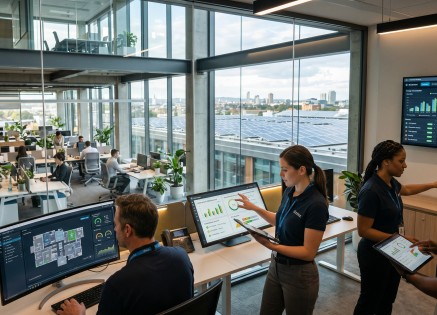
The benefits of facilities management software are increasingly central to modern FM strategy. Among the key pros of digital FM platforms is the ability to shift from reactive to predictive maintenance — reducing costly emergency callouts before they occur. Platforms such as CMMS (Computerised Maintenance Management Systems) and IWMS (Integrated Workplace Management Systems) give managers real-time visibility into asset status, work orders, space allocation, and compliance tracking.
Software-driven FM enables data analytics that would be impossible manually. Decision-making becomes faster, more accurate, and audit-ready. A centralized digital system also reduces coordination errors between maintenance teams, contractors, and building occupants — a problem that costs organizations both time and money at scale.
Facilities managers navigating common operational challenges can use software platforms to flag issues early, before they become costly disruptions.
Benefits of Outsourcing Facilities Management Services
The benefits of outsourcing facilities management services are most compelling for mid-to-large organizations that lack the internal capacity to manage complex, multi-site environments. Outsourcing transfers operational risk, provides access to specialist expertise, and often delivers lower costs through provider economies of scale.
Research from Deloitte's Global Outsourcing Survey consistently shows that FM outsourcing can reduce operational costs by 15–30% while improving service quality through SLA-driven accountability. Outsourced providers also bring compliance knowledge across jurisdictions — a significant advantage for multinational businesses.
The benefits of outsourcing facilities management go beyond cost. Outsourced FM providers typically operate established training programs that keep their staff current on legislation, technology, and best practice — a resource most in-house teams cannot replicate at the same scale.
Benefits of Integrated Facilities Management
The benefits of integrated facilities management (IFM) emerge when all FM services — maintenance, cleaning, security, catering, and energy management — are delivered through a single provider or unified internal team. IFM eliminates the coordination friction that comes with managing multiple vendors across different service streams.
For large commercial portfolios, IFM improves service consistency, simplifies procurement, and produces cleaner data for strategic arrangement. A single integrated contract also reduces administration overhead for in-house managers, freeing them to focus on higher-value work.
Benefits of Total Facilities Management
The benefits of total facilities management (TFM) take integration one step further, covering every aspect of the built environment under one operational umbrella. TFM providers take full accountability for a facility's performance — from reactive repairs to long-term capital planning.
Organizations that adopt TFM models typically report stronger sustainability outcomes, lower total expenses of ownership, and more consistent employee experience across sites. TFM is particularly effective for healthcare, education, and large corporate campuses where service continuity is directly tied to operational outcomes. Some of the world's leading healthcare and education providers have adopted TFM precisely because single-provider accountability reduces the risk of service gaps across complex, multi-building estates.
Benefits of BIM in Facility Management
The benefits of BIM in facility management are transforming how organizations plan, operate, and maintain their built assets. Building Information Modelling provides a 3D digital model of a facility that stores technical data on every component — from structural elements to MEP (Mechanical, Electrical, Plumbing) systems.
When integrated with FM operations, BIM enables predictive maintenance planning, more accurate lifecycle costing, and faster response to building modifications. The UK Government's mandate for BIM Level 2 on public sector projects has made this a standard expectation for modern FM professionals, and the practice is expanding globally. BIM gives FM teams a single source of truth for every element of a building's operation, from commissioning through to end-of-life replacement.
Benefits of Effective Facilities Management on Workforce Productivity
The benefits of effective facilities management on staff productivity are well-documented. A workplace that is well-maintained, comfortable, and compliant with health and safety standards directly supports employee performance and retention. Research published in the Journal of Facilities Management shows that poor physical environments — inadequate lighting, temperature inconsistency, or poorly maintained spaces — reduce employee output by 5–15%. Well-managed workplaces enhance staff retention by signalling that the organization takes employee comfort and safety seriously as operational priorities.
Effective FM ensures that workspaces are safe, functional, and aligned with how modern teams actually work. As hybrid models become standard, facility managers play a vital role in redesigning space utilization to match new patterns of occupancy.
The Role of Safety and Compliance in FM
Safety is one of the most legally significant benefits of facilities management. FM teams are responsible for ensuring buildings meet fire safety standards, COSHH regulations (in the UK), electrical testing requirements, and health and safety legislation. Non-compliance can result in regulatory penalties, insurance voidance, or prosecution.
Organizations with structured FM programmes maintain audit trails, conduct regular risk assessments, and implement corrective actions before regulatory inspections. This proactive compliance posture is especially crucial in sectors such as healthcare, education, and food production, where safety failures carry severe consequences.
In specialist environments — such as veterinary clinics or research facilities where an animal's welfare depends on controlled conditions — FM compliance carries direct ethical and legal weight beyond standard building regulations. Facilities that house animals are subject to additional regulatory frameworks, and FM teams in those environments must integrate welfare standards directly into their maintenance and inspection schedules, making Facilities Management Courses increasingly valuable for professionals working in these sectors.
Energy and Sustainability Benefits
Energy efficiency is among the most commercially valuable benefits of facilities management in 2026. As ESG reporting becomes mandatory across more jurisdictions, FM teams are central to reducing a building's carbon footprint and improving sustainability scores.
FM professionals improve energy performance through lighting upgrades, smart building systems, HVAC optimization, and renewable energy integration. Organizations that treat sustainability as part of FM strategy — rather than a separate initiative — achieve more consistent results and better alignment with corporate net-zero commitments.
Building a Skilled FM Workforce
The benefits of facilities management can only be realized through qualified professionals. Structured Facilities Management Training Courses give current and aspiring managers the technical knowledge and strategic frameworks needed to lead modern FM operations effectively.
Programmes should cover asset management, health and safety law, sustainability standards, contract management, and digital tools. For professionals looking to advance their career in this field, an Online Facilities Management Training Centre offers flexible, accredited learning that fits around existing work commitments.
Organizations that invest in FM training see measurable improvements in compliance rates, maintenance quality, and staff confidence. Professionals who take time to discover and learn FM fundamentals through accredited courses consistently perform better in compliance audits and optimize asset organizing roles.
Benefits of Facilities Management: Summary Table
| Benefit | Impact Area | Key Outcome |
| Preventive maintenance | Cost savings | 25–40% fewer unplanned repairs |
| Energy management | Sustainability | 10–20% utility expenditure reduction |
| Software integration | Decision-making | Real-time data and compliance tracking |
| Outsourcing FM | Cost and expertise | 15–30% operational expenses reduction |
| IFM and TFM models | Coordination | Single accountability, lower admin overhead |
| BIM integration | Planning and lifecycle | Accurate asset data and predictive maintenance |
| Safety compliance | Legal and risk | Reduced regulatory penalties |
| FM training | Workforce quality | Improved productivity and compliance rates |
Conclusion
The benefits of facilities management span financial performance, workforce productivity, legal compliance, and long-term sustainability. Organizations that invest in structured FM — whether through internal teams, outsourced providers, or integrated models — consistently outperform those that treat building management as a secondary concern.
In 2026, FM is a strategic discipline. As buildings become smarter, regulations more demanding, and ESG expectations more concrete, the role of the facility manager has never been more commercially significant. Decision-makers who prioritize FM investment — including professional training, software adoption, and data-driven operations — will discover measurable competitive advantages that compound over time.