The European Union Asks Canada to Become Its First 'Associate Member'
EU proposes landmark associate membership for Canada to bolster transatlantic trade, green energy, and geopolitical alignment amid rising tariff threats.
18/09/2026
Diplomacy and Public Affairs
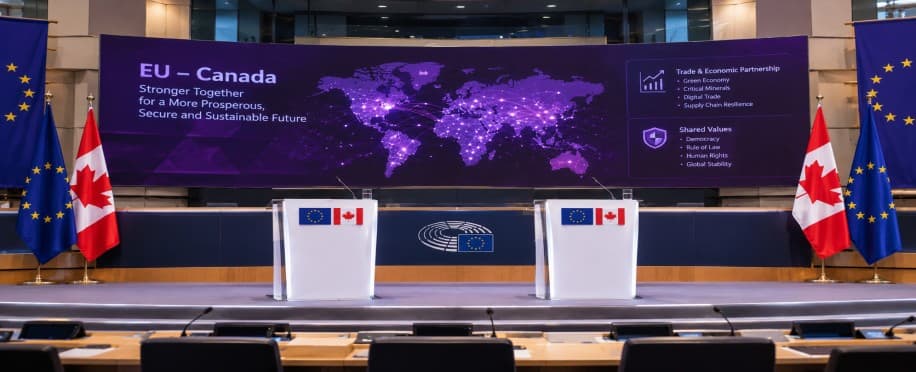
In a significant geopolitical move, Ursula von der Leyen, President of the European Commission, has suggested that Canada could become the European Union's inaugural “associate member.”
Speaking to the European Parliament in Strasbourg with Canadian Prime Minister Mark Carney, she characterised this initiative as a crucial measure for redefining international alliances in the context of rising global instability.
The move follows a significant decline in trans-Atlantic commercial relations due to Donald Trump's return to the White House. In response to unilateral U.S. tariffs and aggressive rhetoric, both Brussels and Ottawa are attempting to strengthen their economic security.
For Canada, which recently halted trade discussions with Washington and imposed retaliatory duties, this proposal indicates a strategic effort to decrease dependence on the American market.
Structure of a First-of-Its-Kind Collaboration
While the European Union has engaged in extensive integration with non-member states like Norway and Switzerland, it has not offered a formal “associate membership” option. Ursula von der Leyen proposed enhancing the Comprehensive Economic and Trade Agreement (CETA) to create a wide-ranging “alliance for the future,” focused on fostering economic security and mutual prosperity.
The proposed agreement encompasses several important sectors, highlighting key pillars for focus.
- Resource and industrial synergy: Involve the joint development of critical minerals, green energy supply chains, and battery manufacturing.
- Technological integration: Entails formal collaboration among artificial intelligence, quantum computing, and cybersecurity.
- Defence and Arctic governance: stress the importance of integrating defence-industrial bases and position the Arctic as a key joint strategic initiative.
Canada has officially applied to join the British-led Joint Expeditionary Force (JEF), a military coalition of 10 northern European countries, highlighting a shift in security strategy, as confirmed by Prime Minister Carney's office.

Washington Issues a Threat of Trade Retaliation
The potential integration of Canada into Europe was met with immediate condemnation from Washington, as President Trump described the idea as “laughable” and threatened economic retaliation if Brussels moved forward.
Notably, Trump indicated that he would impose significant tariffs or halt trade with Europe if he perceives any hostile actions, highlighting the $200 billion trade deficit the U.S. has with the European bloc.
Concurrently, the White House released a memorandum instructing federal agencies to identify Canadian goods for exclusion from U.S. federal procurement, pointing to regulatory challenges that American companies encounter in Canada.
Diplomatic Ambiguities & Domestic Pushback
European diplomats and analysts warn that “associate membership” lacks a legal definition in EU treaties. Scepticism exists among member states about overpromising, particularly since ten nations have yet to ratify the original CETA agreement from a decade ago.
Further, analysts anticipate that the arrangement will likely result in a network of sectoral agreements, enabling Canada to integrate into existing EU frameworks rather than achieving full institutional integration.
Carney encounters significant political challenges in Canada, particularly from the Conservative opposition led by Pierre Poilievre, who opposes proposals that he claims would place Canadian workers and agricultural producers under the influence of unelected European regulatory agencies.
In closing, opposition leaders emphasise that while diversifying is important, Canada will not compromise its sovereignty to either Washington or Brussels.