Humanoid Robots Outperform Humans in the Beijing Half-Marathon, Demonstrating Quick Progress
Humanoid Robots Outperform Humans in the Beijing Half-Marathon, Demonstrating Quick Progress
20/04/2026
Artificial Intelligence (AI)
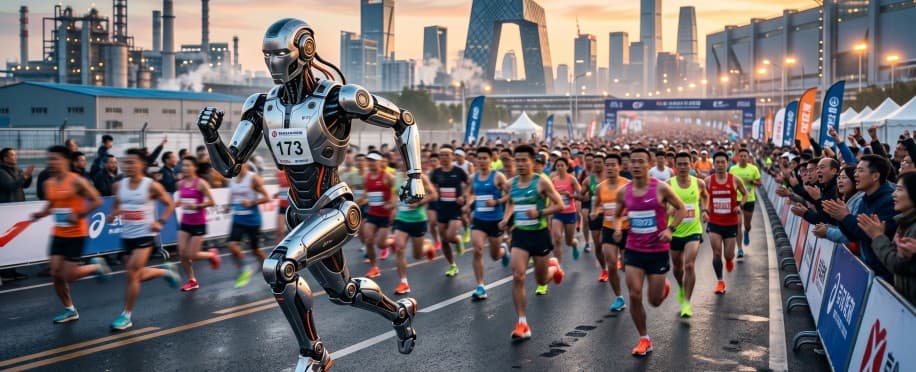
In a recent half-marathon event, a Chinese humanoid robot named “Lightning” outperformed over 12,000 human competitors, completing the 13-mile race in 50 minutes and 26 seconds.
This time, not only won the race but also broke the previous human world record, held by Jacob Kiplimo, by nearly seven minutes.
Lightning experienced a slight delay after hitting a railing near the race's end, but recovered for a dramatic finish. Honor's robots dominated the competition, taking all top three spots on the podium.
China's Humanoids Leap Ahead
Ma Huaze, captain of a winning Honor team, expressed feelings of nervousness regarding the significant challenge of demonstrating courage while performing large-scale upgrades in a competitive environment.
Remarkably, the event in Beijing's industrial park showcased over a hundred robots, an increase from last year's inaugural race, where only six out of 21 humanoids finished. The fastest robot, Tiangong, completed the half-marathon in 2 hours and 40 minutes, significantly slower than a human professional athlete.
China has made notable technological strides this year, highlighted by four humanoid robots completing tasks in under an hour with reduced malfunctions. Human runners, maintaining a safe distance, admired the robots' speed, and some even took photographs of them.
China's Robot Race: Raising the Stakes
The fastest competitor, 29-year-old Zhao Haijie, completed the race in 1 hour, 7 minutes, and 47 seconds. In an NBC News interview, he remarked on the speed of the robots, stating, “It just went whoosh right past me” during the first 3 miles.
Navigating various obstacles, around 40% of robots completed tasks autonomously, while others were remote-controlled with adjusted finishing times. Moreover, spectator Liu Yanli expressed optimism about technological advancements, noting the security for the future it offers middle-aged individuals, while his son Jinyu recognised the robots' capability to carry a lot of things.
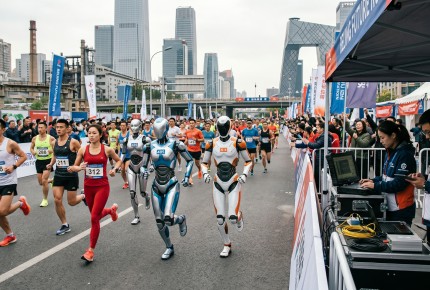
The development of advanced humanoid robots is a competitive race between China and the U.S., illustrated by Intercity Technology Co.'s progress with its child-sized robot, Xiao Cheng. Founder Xue Qingheng stated the focus this year is on improving their own capabilities, with notable enhancements in motor speed, coordination, sensors, and gait algorithms.
According to city officials, the race champion will receive over one million yuan ($146,500). The event attracted significant viewership in a country with over 150 companies and research labs focused on humanoid robotics. China's strategic push for robotics and AI, backed by state subsidies, aims to dominate this industry, considered a “national priority.”
Robot Stumbles Highlight China's Big AI Bet
China leads in the supply chain for AI chips, sensors, and batteries, with a master plan for 2026-2030 focused on advanced technologies such as brain chips, quantum computing, and humanoid robots for industries and daily life, including tasks like maintaining electrical grids and elder care.
China's recent half-marathon event highlighted its development ambitions, though it encountered challenges. Technicians monitored the race from golf carts, prepared for emergencies. Notably, one robot fell near the start but continued racing with repairs, while another completed the race only to veer off course and land in a bush.
Further, Xiao Pai, a 2-foot-tall companion robot, demonstrated its abilities by carrying a baby bottle. Expert Xue highlighted that while robots have advanced physically, they still lack sophisticated intelligence. He remains optimistic that solving this “brain problem” will lead to significant innovations.