Connect AI in Event Management and Attendee Engagement
Personalisation becomes useful when it helps people decide how to spend their time. An attendee who wants to discover relevant suppliers has different priorities from someone seeking professional development.
Recommendation features can suggest sessions or contacts based on declared interests. Such capabilities already appear in commercial event platforms, although their availability should not be confused with proof that they improve every programme.
For example, a finance director attending a technology exhibition might receive suggestions focused on investment appraisal. However, delegates should still be able to browse the full programme and change their preferences. Useful recommendations expand their options without making those choices for them.
This transforms personalisation into a service with a clear purpose. Measure whether suggested sessions were attended and whether recommended introductions produced useful conversations; clicks alone reveal much less about the quality of those experiences.
Give Delegates Faster, More Reliable Answers
A conversational assistant can help with routine questions, but its answers must come from approved material. Registration instructions should match the booking system, while schedule information needs updating whenever arrangements change.
Research offers a relevant example. The 2023 working paper Generative AI at Work reported an average productivity increase of approximately 14% among customer support agents given an AI assistant. This was a customer-service study, so the figure should not be treated as a forecast for conferences.
The practical lesson for AI in event management is to test assistance against actual service outcomes. Can delegates get correct answers more quickly? Can staff handle difficult enquiries without repeating information already provided?
An assistant should offer a clear route to a person when it cannot resolve a request. For sensitive accessibility arrangements or disputed refunds, the escalation process matters as much as the initial response.
Apply AI in Venue and Event Management Carefully
Venue decisions combine operational constraints with delegate needs. AI tools can help compare documented requirements against venue specifications, but the organiser must verify important details directly.
For a London leadership summit, an AI-generated comparison could highlight missing information about accessible entrances or breakout capacity. That gives the team specific questions to raise during a site visit rather than an assumption that the venue meets every requirement.
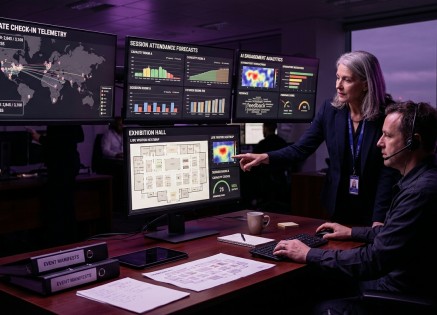
Similarly, aggregated check-in information may help staff anticipate busy periods. However, an AI recommendation cannot replace approved safety arrangements or the judgement of qualified personnel. Keep operational responsibility clearly assigned.
Address AI Ethics in Event Management Early
Personalisation depends on information about people, which makes privacy part of the design decision. UK organisers should consider how they explain processing and limit information to what is needed; both transparency and data minimisation feature in the ICO’s AI guidance.
Before sharing registration records with a provider, establish how they will be used and retained. Check whether the service uses submitted information to train its models, and involve your privacy lead in assessing the proposed arrangement.
Fairness also needs attention. If networking recommendations repeatedly favour senior job titles, newer professionals may receive fewer opportunities. Review who benefits from the system and offer alternatives for attendees who prefer direct browsing or staff assistance.
Staff responsible for these checks need to recognise unreliable outputs and question automated recommendations. Developing AI skills for future workplace success can help them approach that responsibility with greater confidence.
Introduce AI in Traditional Event Management Gradually
The first step is to select one workflow, one accountable owner and a defined trial period. This makes it easier to identify whether improvements come from the technology or from changes elsewhere in the process.
Before expanding AI in event management, follow these steps:
- Record the current workload and error rate.
- Test with approved information from a previous programme.
- Review incorrect outputs and unusual requests.
- Run a limited pilot with human oversight.
- Compare benefits with the full delivery cost.
Team capability deserves equal attention. Conducting an AI skill gap analysis helps identify where employees need support before taking responsibility for new systems.
Prepare Teams for Everyday Use
Before introducing AI into live delivery, give employees time to practise with realistic situations. A rehearsal can reveal whether they know how to correct an inaccurate answer or escalate a request that needs personal attention.
For distributed teams, artificial intelligence courses online can support this preparation. Choose training that reflects the tasks employees will perform, then reinforce it through supervised practice before the next event.
Measure the Results of AI in Event Management
Evaluating AI in event management requires a broader view than subscription costs. Include setup work, integration and staff review time when calculating whether the investment delivers value.
For example, suppose an assistant saves ten staff hours, but checking its answers requires eight hours. The net saving is two hours before other costs. Equally, faster responses offer little benefit if delegates need to contact the team again to correct mistakes.
Track service quality alongside efficiency. That provides a stronger basis for deciding whether to expand the pilot, adjust the workflow or discontinue it.
For managers assessing the investment, artificial intelligence courses can support a clearer understanding of AI applications and their limitations. Prioritise learning that helps participants evaluate business cases and define meaningful success measures.
Conclusion
AI in event management supports smarter decisions when it addresses a defined operational need. Begin with a measurable problem, verify outputs and retain clear human responsibility. For leaders, the investment case rests on better service and demonstrable value after implementation costs are included.