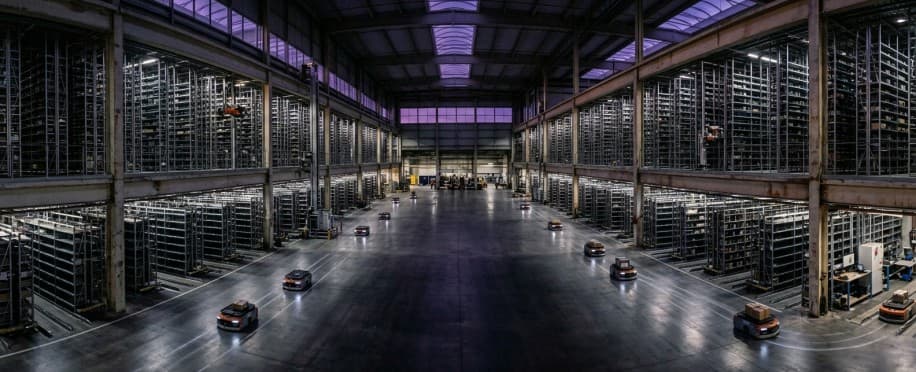
1. Improve Warehouse Efficiency and Order Fulfilment
One of the most immediate benefits of logistics automation is the ability to process orders more quickly and consistently. In conventional warehouses, employees may spend considerable time locating products, checking quantities and transferring information between systems. These activities become particularly demanding during seasonal peaks or periods of unexpected demand.
Imagine a distribution centre preparing several hundred orders before an afternoon dispatch deadline. If inventory locations are inaccurate, employees may spend valuable time searching for products or correcting picking mistakes. Automated inventory records and digital picking instructions help workers locate items more efficiently, while connected systems update order progress as tasks are completed.
For managers, this creates another important advantage: better control over daily performance. When order information is available in real time, supervisors can identify delays earlier and reallocate employees or equipment before problems affect scheduled shipments.
Still, technology should solve a clearly defined operational problem. Businesses can begin by examining practical ways to improve logistics processes, particularly where unnecessary handling or disconnected activities reduce productivity.
2. Reduce Operating Costs Through Better Resource Utilisation
Logistics expenses often increase through small inefficiencies that accumulate across daily operations. Repeated warehouse movements, underutilised vehicles and inaccurate stock records can gradually reduce profit margins, especially when businesses manage large distribution networks.
The financial benefits of logistics automation come from identifying these inefficiencies and improving how resources are allocated. Automated transportation planning, for instance, can help dispatchers evaluate delivery routes according to distance and vehicle capacity. Meanwhile, connected inventory systems can reduce unnecessary stock checks and help purchasing teams avoid excessive replenishment.
For decision-makers, three areas deserve particular attention:
- Labour productivity: Reducing repetitive administrative tasks allows employees to concentrate on activities requiring judgement and coordination.
- Transportation efficiency: Better route planning can improve vehicle utilisation and limit avoidable mileage.
- Inventory costs: More accurate stock information supports purchasing decisions and helps businesses avoid unnecessary storage expenses.
However, the investment itself requires careful evaluation. New equipment introduces maintenance expenses, while software platforms may involve subscription and integration costs. Managers should therefore compare expected operational savings against the total cost of ownership.
In practice, the benefits of logistics automation are strongest when investments address measurable inefficiencies and produce savings that can be sustained over time.

3. Improve Inventory Accuracy and Supply Chain Visibility
An inventory discrepancy can affect much more than a warehouse record. When systems show products that are unavailable, purchasing teams may delay replenishment, while customer service employees communicate delivery dates that cannot be achieved.
Automated tracking helps address this problem by recording stock movements as goods are received, transferred and dispatched. Among the top benefits of RFID automation in logistics is the ability to identify multiple tagged products without individually scanning each barcode. In suitable environments, this makes inventory verification faster and reduces repetitive checking.
However, reliable tracking also depends on accurate information. If different departments maintain inconsistent records, even sophisticated equipment can produce misleading results. Connecting inventory systems with purchasing and order management platforms helps ensure that employees work with more consistent information.
The benefits of logistics automation become especially valuable across international supply chains. Consider a manufacturer waiting for components from an overseas supplier. If shipment tracking reveals a potential delay, production managers can review available stock and adjust schedules before the disruption affects customer commitments.
4. Make Smarter Decisions with AI and Predictive Analytics
Automation is increasingly supporting decisions that previously depended on extensive manual analysis. AI-powered systems can examine historical demand, identify purchasing patterns and recommend adjustments to transportation schedules.
For example, a distributor may experience a sudden increase in demand for a particular product. Predictive analytics can help identify whether existing inventory will cover expected orders and recommend replenishment before shortages occur.
More advanced techniques can also support transport planning. If a shipment encounters congestion at a major port, intelligent software may identify alternative routes or recommend changes to delivery schedules. Managers can then compare the available options against service commitments and additional expenses.
As seen in the DHL Logistics Trend Radar 8.0, published in September 2026, artificial intelligence is moving beyond analytical assistance towards systems capable of planning and coordinating activities under human oversight. The report also examines how robotics and connected technologies are transforming logistics roles and workplace requirements.
Why does this matter for business leaders? These developments can help organisations respond faster to changing conditions, but successful adoption still depends on human expertise. Employees must understand the recommendations generated by intelligent systems and evaluate their commercial consequences.
The benefits of logistics automation therefore extend into management itself, where faster information processing can support more informed decisions.
5. Improve Delivery Reliability and Customer Experience
Customers expect deliveries to arrive when promised, but they also expect accurate information when schedules change. For companies supplying industrial materials or time-sensitive products, unreliable communication can disrupt customers' own operations.
One of the most customer-focused benefits of logistics automation is the ability to provide consistent shipment updates. Connected tracking systems can generate notifications when orders are dispatched or when expected arrival times change. This reduces the need for customers to repeatedly contact support teams for routine information.
The benefits of automated outbound calling for logistics companies are also relevant here. Automated calls can confirm delivery appointments, provide arrival updates and help coordinate deliveries when recipients need to be present.
Of course, some situations still require personal attention. A delayed shipment involving customs complications or damaged goods may need an experienced employee to investigate the problem and coordinate a suitable resolution.
For logistics providers, combining timely digital communication with reliable human support can improve customer confidence and strengthen long-term commercial relationships.
6. Build a More Flexible and Resilient Supply Chain
Unexpected demand, supplier shortages and transportation disruptions can quickly affect distribution performance. Although companies cannot prevent every disruption, they can improve how quickly their teams identify problems and coordinate responses.
The benefits of logistics automation become particularly valuable when organisations manage several warehouses or operate across different regions. For example, if demand increases unexpectedly in one location, connected systems can identify available stock elsewhere in the network. Managers can then evaluate whether transferring inventory would be faster or less expensive than placing additional supplier orders.
This flexibility also depends on employees understanding how to interpret information and make operational decisions. Managers seeking to strengthen these capabilities can explore logistics and supply chain management courses in Riyadh, particularly when developing their knowledge of distribution planning and resource coordination.
Another consideration is how organisations prepare employees working across different locations. For these teams, logistics and supply chain management courses online can support consistent professional development while reducing the need for travel.
How Can Businesses Implement Logistics Automation Successfully?
Successful implementation begins with identifying a business problem rather than selecting technology based on its features. A warehouse experiencing frequent inventory discrepancies, for example, may achieve greater improvements by introducing reliable tracking procedures before investing in expensive robotic handling equipment.
The first step is to review existing operations and establish clear performance objectives. Managers should identify where delays occur, how much manual work is involved and which activities create unnecessary expenses. These findings provide a baseline for evaluating improvements.
A practical implementation approach includes three stages:
- Assess operational requirements: Identify recurring inefficiencies and determine which systems could address them effectively.
- Test technology before expansion: Introduce automation within a manageable process to evaluate integration requirements and actual performance.
- Prepare employees and measure results: Provide practical training, establish responsibilities and compare outcomes against the original objectives.
Following these industry best practices can help organisations identify technical problems before introducing new systems across larger operations.
Employee involvement is equally important. Workers who understand how automated systems affect their responsibilities are better positioned to identify problems and suggest improvements during implementation.
Ultimately, sustaining the benefits of logistics automation requires continuous evaluation. Organisations should review performance regularly and adjust their systems as operational requirements evolve.
It is also useful to examine how international markets are responding to changing industry requirements. For example, businesses can explore logistics and supply chain skills development in Singapore to discover the professional competencies supporting increasingly connected distribution operations.
What Challenges Can Limit Automation Success?
Although automated technologies can improve efficiency, they also introduce challenges that require careful management. Older software may struggle to exchange information with new platforms, while inaccurate records can affect automated decisions.
Consider a company introducing automated stock replenishment. If inventory records contain incorrect quantities, the software may recommend unnecessary purchases or fail to identify genuine shortages. The technology could operate correctly while producing undesirable financial results because its underlying information is unreliable.
To reduce these risks, organisations should prioritise three areas:
- Data quality: Review existing records and correct inaccuracies before connecting new systems.
- Employee readiness: Involve frontline teams in testing and provide training relevant to their responsibilities.
- Operational continuity: Establish backup procedures for technical failures and interruptions.
Cybersecurity also deserves attention. As equipment and software become increasingly connected, organisations must protect operational information and manage access to critical systems.
Addressing these issues early helps managers build confidence in new technologies and maintain service reliability during the transition.
How Can Managers Measure Automation Performance?
Understanding the benefits of logistics automation requires measuring what changes after implementation. Without clear performance indicators, managers may struggle to determine whether a technology investment has genuinely improved productivity or reduced expenses.
The most useful measurements depend on the original objective. A warehouse introducing automated picking equipment might monitor order processing times and picking accuracy. A transportation provider implementing route optimisation software could evaluate delivery reliability and cost per shipment.
Managers should compare these results against performance recorded before implementation. Reviewing several operating periods also helps account for seasonal fluctuations and changes in order volumes.
More importantly, measurement should lead to practical decisions. If processing speed improves while order accuracy declines, teams may need to adjust procedures or provide additional training. Similarly, if a system delivers smaller savings than expected, managers should investigate whether operating conditions or integration problems are limiting performance.
Continuous monitoring helps organisations maintain the benefits of logistics automation while ensuring that improvements support overall business objectives.
Conclusion
The benefits of logistics automation extend across warehouse productivity, inventory management and transportation reliability. By improving information flow and reducing repetitive work, connected systems can help organisations control expenses and respond more effectively to changing operational requirements.
However, achieving these improvements requires careful technology selection and clear performance objectives. Businesses also need employees who understand how to work with automated systems and manage situations requiring professional judgement.
For logistics leaders, the most valuable starting point is identifying where inefficiencies create the greatest operational or financial impact. From there, selecting suitable solutions and measuring performance can support more efficient operations and long-term competitiveness.