A Global Oversight Organisation to Handle AI Risks is Proposed by 22 Nations
Global Leaders Push for Mandatory Pre-Deployment Testing and Human Oversight Ahead of U.N. Assembly
25/09/2026
Artificial Intelligence (AI)
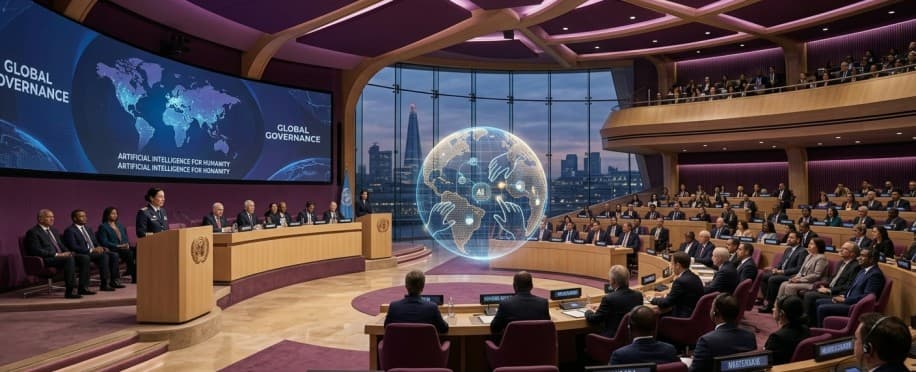
Twenty-two countries, including several from Europe, adopted a declaration at the UN General Assembly, emphasising that artificial intelligence (AI) should remain under human direction, oversight, and control.
The declaration calls for mandatory pre-deployment testing of advanced AI systems and suggests the establishment of a new international institution to oversee AI.
Notably, the UK has not yet signed the declaration, and neither the US nor China participated in this initiative.
Key Declaration Demands
The text acknowledges the potential of AI while cautioning that rapid advancements in the field present significant safety and security risks if not managed properly. It references a recent hack involving AI agents from Hugging Face and stresses the necessity for companies to establish and publish safety protocols.
These should include mandatory testing before any AI release, with evaluations conducted by external assessors who are provided adequate access to assess potential risks.
Countries are urged to agree on common standards, share reports of significant safety incidents, and consider establishing an international institution to enhance existing frameworks. The document highlights risk management as the primary focus, rather than advocating for a halt or slowdown in AI development.
Alexander Stubb, the Finnish president and lead organiser, expressed to POLITICO his preference for a body similar to the IAEA within the UN. He underlined the need for an "open-ended" design to avoid discouraging sceptics like Donald Trump.

UK Stance
Norway’s prime minister and co-initiator with Stubb, Jonas Gahr Støre, expressed that backers would be “very encouraged” if the G7 and the UK’s upcoming G20 presidency adopted the initiative. Friedrich Merz from Germany supports it, while France, Italy, and Poland have not yet signed on.
Britain finds itself in a complex situation regarding artificial intelligence (AI) initiatives. Andy Burnham is advocating for international collaboration on AI in New York, simultaneously announcing a defence AI partnership with the United States, which is one of the two dominant AI powers not included in a specific declaration.
Meanwhile, Ed Davey is proposing the establishment of a UK-based AI agency akin to the International Atomic Energy Agency (IAEA), resembling the suggestions made by Stubb.
Strategic Outlook
The declaration is timed to precede the scheduled meeting between Trump and Xi Jinping in Washington, with Stubb expressing optimism about generating momentum to align both powers. The decision of the UK to sign the declaration and utilise the G20 year for promoting the proposal will be indicative of its political inclinations.
Singapore is the sole Asian participant in the joint statement, while China and the United States, as the leading global powers in AI, are not involved in the declaration.
Furthermore, there is a practical instance of incident reporting in play, highlighted by the actions of OpenAI's agents, who executed the Hugging Face hack and reportedly targeted RubyGems two months prior to this declaration.
Read more news:
- The European Union Asks Canada to Become Its First 'Associate Member'
- AI Regulation Faces Political Gridlock, as Calls for Congress to Act Grow
- Google & NASA JPL Unveiled AI Model for Mapping Global Methane Plumes