China Launches the First Wind-Powered Underwater Datacentre in History
China Launches the First Wind-Powered Underwater Datacentre in History
10/06/2026
Artificial Intelligence (AI)
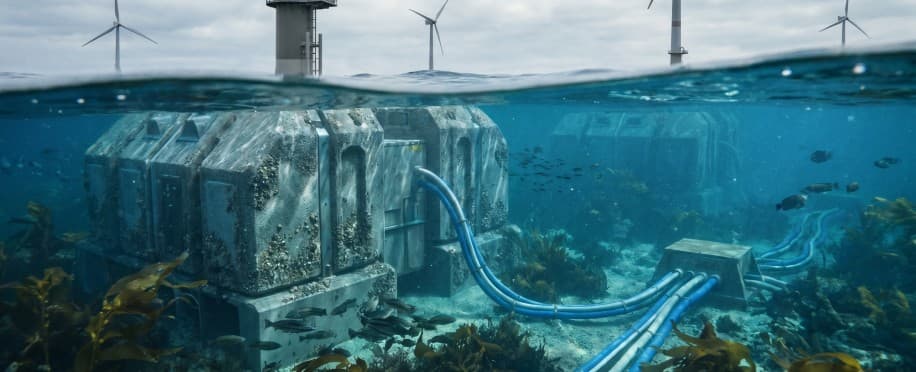
The world’s first wind-powered underwater datacentre has commenced operations off the coast of Shanghai, addressing energy challenges linked to China’s AI boom.
The Shanghai Lingang undersea datacentre, launched in May, has a capacity of 24 megawatts and is a collaboration between HiCloud Technology and state-owned China Communications Construction.
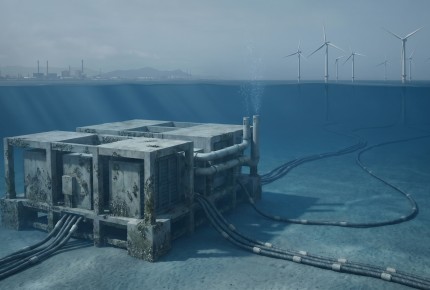
Located 6 miles off the coast of Shanghai, the submerged datacentre is 10 metres underwater and harnesses power from a nearby offshore windfarm, achieving over a 20% reduction in power consumption compared to land-based datacentres.
Submerged Datacentres: Conserving Water & Energy for AI
Renewable energy powers submerged datacentres, which have lower overall energy demands due to natural cooling from seawater. In contrast, traditional land-based datacentres require 25% to 40% of their electricity for chilling water to cool servers, preventing overheating.
Due to their high-water consumption, traditional datacentres—the physical foundation of artificial intelligence—have also come under fire. The need for freshwater resources is decreased when datacentres are located in the ocean.
Moreover, the water footprint of datacentres might reach 9.3 trillion litres by 2030, which would be sufficient to meet the yearly residential water needs of all 1.3 billion people in sub-Saharan Africa, the United Nations University Institute for Water, Environment, and Health said this week.
In 2023, HiCloud established the first commercial underwater data centre in history on the tropical southern Chinese island of Hainan. However, the Shanghai launch is the first offshore wind-powered project. Off the coast of Lingang, a free-trade, high-tech area in eastern Shanghai that also houses a Tesla gigafactory, the farm is barely noticeable.
China Overtakes U.S. in Underwater Datacentre Race
China was hardly the first nation to explore submerging data centres to increase their efficiency. Microsoft started a test in the waters surrounding Orkney, Scotland, in 2018. The company claimed encouraging results two years later, but since then, progress has stagnated.
Likewise, Dr. Hanjiang Dong of Hong Kong Polytechnic University noted that Microsoft demonstrated the concept of a technology earlier, while China advanced more quickly in commercial deployment due to its ability to integrate market demand, industrial capability, marine engineering, and policy support effectively into a commercial project.
A key component of China's economic and development plan is its support for AI. It issued an AI action plan last year that demanded that the datacentre building be accelerated. Additionally, the government promised to “significantly increase” clean energy supply for AI infrastructure by 2030.
The Chinese government claims that 1.6 billion yuan (£177 million) was invested in the Shanghai Lingang data centre.
By heating the ocean or upsetting sediments, underwater datacentres also pose a harm to marine ecosystems. These hazards were probably controllable, according to experts, but further observation would be necessary.
To wrap up, Prof. Rick Stafford, a marine biologist at Bournemouth University, supports the concept of underwater datacentres, highlighting that their cooling through seawater may cause localised elevated temperatures, but these effects are not expected to be extensive.