Google Cloud Presents the Gemini Agent
AI is not a replacement for human intelligence, but the catalyst that scales our potential into the future.
12/10/2026
Artificial Intelligence (AI)
At a recent Google Cloud event, the company introduced Gemini AI, marking a significant shift into the agentic age. This advancement features a unified agent capable of not only responding to user inquiries but also performing tasks on behalf of the user, all through a single, integrated interface.
AI tools have evolved from mere conversational functions to capabilities that include task ownership, code generation, and organisational tasks such as scheduling meetings and booking appointments.
This shift is complemented by the emergence of consumer-focused agents, exemplified by Meta’s Muse and various messaging platforms like Instinct, alongside the recent launch of ChatGPT’s Dots.
Google Debuts Goal-Driven Gemini Agent for Businesses
As noted by Google CEO Sundar Pichai, the company is in a strong position to scale its agentic efforts, with over 1 billion monthly active users for Gemini. Additionally, nearly 90% of Fortune 100 businesses currently utilise Gemini Enterprise in their operations.
Moreover, Google plans to prioritise the deployment of its Gemini agent in the corporate sector before making it available to consumers. CEO Sundar Pichai stated that this approach enables the company to address significant challenges related to security, scalability, and performance that accompany the introduction of such advanced AI agents.
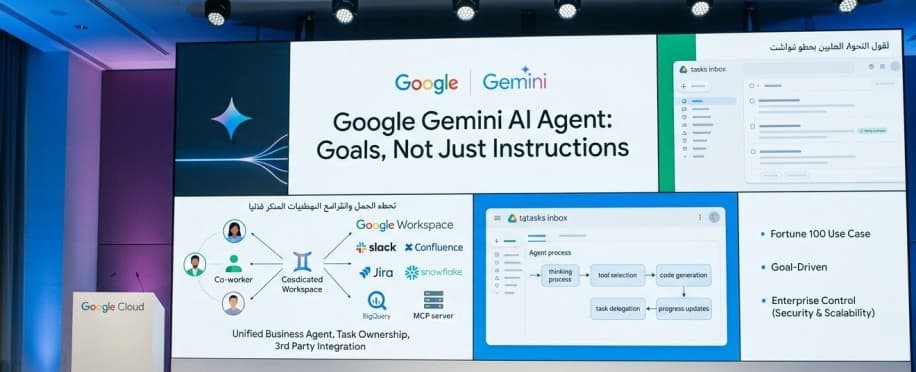
CEO of Google Cloud, Thomas Kurian, stated that the new agent can be assigned “objectives, not just instructions,” enabling it to plan tasks, utilise custom skills and tools, and integrate with businesses' internal systems to achieve its goals.

Gemini Adds Multi-Model Selection & MCP Tools
By default, the AI selects the optimal model for task completion. However, users have the option to manually select a model, including third-party options like Anthropic’s Claude models. Google plans to further enhance the model selection feature by incorporating open-source and additional private models in the future.
The request may contain attachments such as files, folders, or projects tailored for specific workstreams. The agent can access the business's data and systems, including Google Workspace, Microsoft 365, Slack, Jira, Confluence, Git, BigQuery, Databricks, Postgres, Snowflake, among others.
Further, Gemini can connect securely to any Model Context Protocol (MCP) server, both within and outside the company network. Users can monitor its operations through a “tasks inbox” interface, which displays its thinking process, task delegation to subagents, loading of special skills, code, and progress updates.
Gemini Gains an Independent Workspace Identity & Audit Trail
According to Google, the AI will function as a distinct co-worker with its own Workspace account, complete with a dedicated email address and individual context. This AI knows team affiliations, time zones, and approval needs within the company, as well as employee calendars.
Users can interact with the AI by tagging, emailing, sharing, or including it in group chats. Actions taken by the AI will generate an audit trail that is attributed to the AI itself, rather than to an individual user.
Furthermore, the agent is compatible with iOS, Android, Windows, Mac, command line, Google Workspace, Microsoft 365, ServiceNow, and Slack. Early testers included On, Shopify, and PayPal, while Gemini Enterprise customers feature major companies such as BNP Paribas, Bradesco, Merck, Orange Spain, Santee Cooper, SOMPO, Ulta Beauty, and Wesfarmers.
Overall, Google has introduced flexible spending options such as multi-model orchestration, smart routing, and real-time spend caps to assist businesses in better managing their enterprise AI costs.
Read more news:
- November will See the Largest Change to UAE Government Services
- A Global Oversight Organisation to Handle AI Risks is Proposed by 22 Nations
- The European Union Asks Canada to Become Its First 'Associate Member'