China Launches Gravity-1 Rocket from Sea, Sets Nine Satellites in Orbit
Innovation reaches its greatest heights when bold ideas meet precise execution.
23/07/2026
Shipping, Maritime & Ports
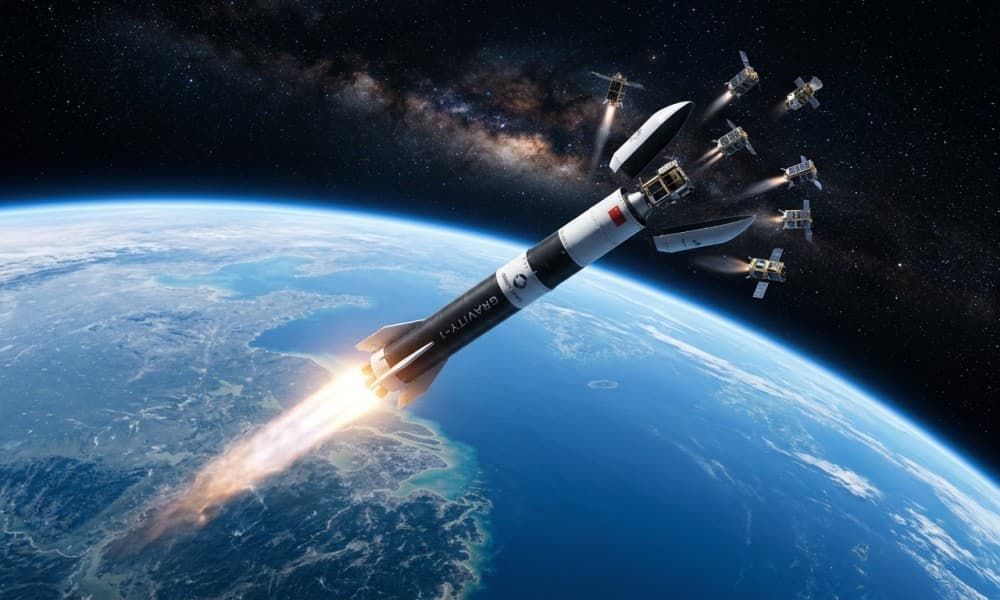
The most potent solid-fuel rocket in the world, China's Gravity-1 launch vehicle, has successfully launched from a sea-based platform at a location in the East China Sea, marking its longest departure from the operator's shoreside base to date.
Gravity-1 is a squat-shaped, 100-foot-tall rocket that can carry a 6.5-tonne payload. It runs from the deck of a big lift ship that has been properly modified. Because it runs on solid fuel, it doesn't need the weight, volume, personnel, or risk of a liquid fuel loading system on board.
According to the Haiyang Aerospace Industry Development Centre, it can stay in a ready-to-go state for prolonged periods of time without human involvement because it doesn't use volatile or cryogenic fuels.
Offshore Launch Deploys Nine Satellites
This is especially useful for at-sea launches farther offshore since the rocket can travel through space with its fuel pre-installed and undisturbed. According to the operator, there is a five-hour wait between final manufacture and launch readiness.
Since 2024, there have been three successful launches, including this one. The rocket took off from the deck of the heavy cargo carrier Dong Fang Hang Tian Gang (IMO 9980473) and transported nine satellites, including remote sensing satellites, to sun-synchronous orbit (SSO).
Approximately 30 to 40 nautical miles off the coast of Shanghai, the launch site was located far south of the Oriental Space Port in Haiyang, Shandong Province.
Gravity-1 Advances Sea Launch
Orienspace, a Chinese company, created its first product, Gravity-1. The company's next goal is to create a liquid-fuelled centre booster that will allow the rocket to be partially reused, which is crucial for reducing launch costs.
Although the concept of sea launch services has been around for a while, at-sea booster recovery (post-launch) is increasingly popular. The Sea Launch collaboration was established in the 1990s after an international endeavour to convert an offshore semisubmersible rig into a launch platform was successful.
Up until 2014, commercial payloads were launched into orbit using Russian Zenit rockets. Key Ukrainian involvement in the project was terminated by the Russian annexation of Crimea, and Sea Launch shut down that year.
Read more news:
- European Petrol Prices Rise on Fears the US-Iran War May Produce Winter Shortages
- Burnham to Become Prime Minister & Outline Ten-Year Plan for the UK
- Google Now Allows You to Directly Add Your Favourite Apps to AI Mode