SpaceX's Sci Fi-Inspired IPO: Musk Aspires to Funds, Power, and a Cosmic Future
SpaceX's Sci Fi-Inspired IPO: Musk Aspires to Funds, Power, and a Cosmic Future
21/05/2026
Artificial Intelligence (AI)
The much-awaited IPO filing from SpaceX has finally arrived, and it reads more like a manifesto for a civilisation getting ready to depart Earth than a conventional Wall Street paper.
Elon Musk's rocket company, which spans 277 pages, combines financial disclosures with technical language, cosmic ambition, and a clear declaration of Musk's intention to maintain almost complete control even after going public.
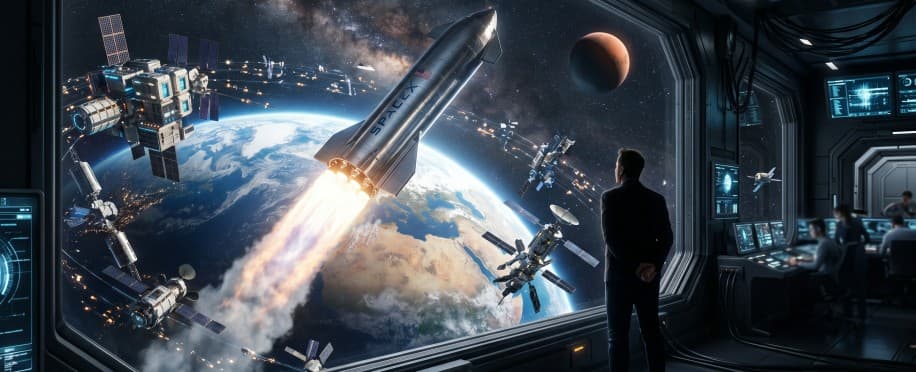
SpaceX's IPO prospectus stands out in the finance industry, featuring expected revenue data, risk factors, and governance systems, along with imaginative graphics of planets and spacecraft that evoke classic science fiction themes.
An S-1 Filing with a Sci-Fi Vision
SpaceX’s IPO prospectus breaks conventional financial norms by integrating revenue figures and risk factors with vivid imagery of planets, spacecraft, and futuristic ideas reminiscent of classic science fiction.
Clearly, the filing admits that several of its “future markets”—from asteroid mining to orbiting AI compute—do not yet exist. Nonetheless, SpaceX claims that these sectors “will develop over time,” establishing itself as the firm that plans to construct them.
Moreover, SpaceX's filing highlights the challenges of “cryogenic propellant transfer in microgravity,” a term for its efforts to create orbital refuelling infrastructure. The company notes that ultra-cold fuels act unpredictably in low gravity, making this task one of its toughest engineering challenges, essential for establishing a multiplanetary civilisation.
SpaceX discusses humanity's potential evolution to Kardashev Type II status, a hypothetical civilisation that can utilise its star's total energy. Meanwhile, the company emphasises its goal to “extend the light of consciousness to the stars” repeatedly, underscoring Elon Musk's belief that human survival hinges on expanding beyond Earth.
A Business Based on AI, Rockets, and Satellites
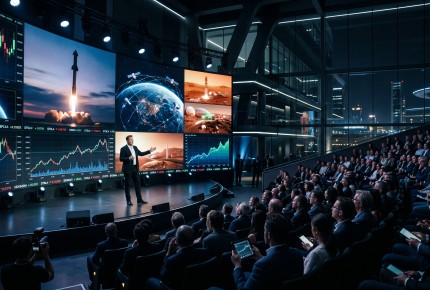
SpaceX aims to list on the Nasdaq with the ticker SPCX, targeting a valuation of approximately $1.75 trillion and seeking up to $80 billion in new investment, revealing insights into its financial operations.
Notably, SpaceX reported $18.7 billion in revenue for 2025, with Starlink, its connectivity division, generating $11.4 billion. In the first quarter of 2026, Starlink alone made over $3.2 billion.
Despite significant investments exceeding $20 billion in capital expenditures last year, the company is experiencing rapid cash depletion, reporting a $4.2 billion loss in Q1 2026.
This expenditure primarily supports AI infrastructure, including the purchase of Musk's AI startup xAI and initiatives for orbital data centre satellites.
Additionally, SpaceX names prominent AI companies as rivals, such as OpenAI, Anthropic, and others. This is a significant change for a business that has always been associated with rockets rather than algorithms.
From Starman to Lunar Mass Drivers: Musk's Myth-Making Persists
The file also revisits some of Musk's more dramatic moments, such as the 2018 Falcon Heavy launch, which launched a Tesla Roadster into orbit with a mannequin named Starman, a tribute to David Bowie.
Other ideas in the prospectus seem like intentional references to science fiction:
- Early sci-fi novels spurred the development of lunar mass drives, which are electromagnetic launch devices.
- Asteroid mining involves obtaining metals and water from near-Earth asteroids.
- Space-based data centres for artificial intelligence can minimise energy and cooling needs on Earth.
While these concepts are hypothetical, they support the story that SpaceX is selling: a corporation that is not only creating rockets, but also designing humanity's future.
Musk Maintains Control as SpaceX Goes Public
If the sci-fi rhetoric denotes ambition, the governance structure suggests caution—specifically, Musk's concern about losing control again.
The filing describes three procedures to ensure Musk remains firmly in control:
- Musk will be CEO, CTO, and board chair, with the authority to appoint or dismiss Class B directors.
- Class B shares, held by Musk and insiders, have more voting power.
- SpaceX will have a controlled business status, exempt from governance obligations such as independent compensation and nominating committees.
Musk currently wields more than 85% of voting power, guaranteeing that even when public investors buy in, strategic control remains concentrated in his hands.
The structure is similar to other founder-dominated businesses, such as Meta and Alphabet, and also follows lessons Musk learned from Tesla, where he has significantly less voting power.
A Business Offering Rockets & the Future
SpaceX's IPO filing is more than just a financial document; it's a story about humanity's future, written with the assurance of a firm that sees itself as a link between Earth and space.
When SpaceX begins trading on June 12, investors will be able to see if they support that ambition or are concerned about the risks, losses, and Musk-centric governance.