World Bank Predicts UAE Economy to Bounce to 9.5% in 2027, Highlighting UAE's AI Leadership
World Bank: AI leadership and economic diversification to drive UAE growth in 2027
13/10/2026
Accounting, Finance & Budgeting
The UAE is expected to grow by 9.5% next year, while Qatar and Kuwait are projected to rebound more sharply at 26.7% and 22%, respectively, after contracting by 20.9% and 14.6% in 2026.
Notably, this World Bank forecast highlights the UAE as a rapidly growing GCC economy for the coming year, while predicting a 4.3% contraction in the GCC economy in 2026, followed by a 10.3% rebound in 2027, depending on the easing of disruptions early next year.
UAE Minister of Tourism and Economy Abdullah bin Touq Al Marri emphasised the importance of contextualising the projected economic rebound.
He noted that a typical rebound is around 4-5%, whereas the expected 10% growth reflects output being shifted from previous years, essentially doubling the anticipated growth for 2027, as reported by the World Bank.
Economic Momentum Recovers
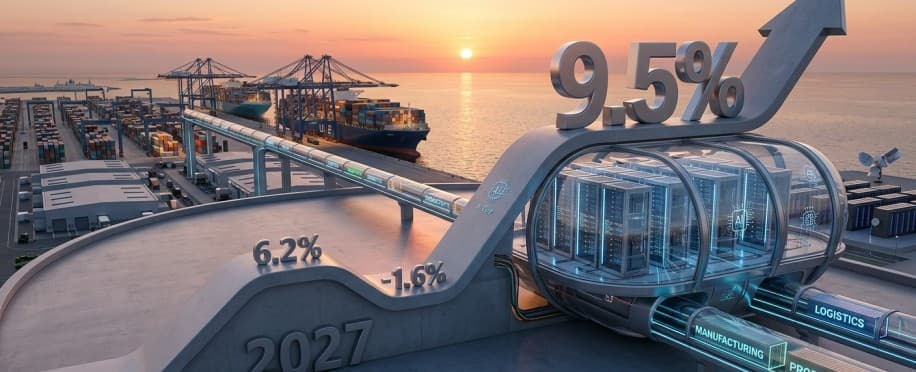
The World Bank predicts UAE GDP growth of 6.2% in 2025, followed by a 1.6% contraction in 2026, and a 9.5% expansion in 2027. This volatility highlights the significant disruption faced by Gulf oil exporters this year, primarily due to the closure of the Strait of Hormuz, which has negatively affected Gulf economies unlike past energy shocks.
Besides, GCC economies are predicted to shrink by 4.3% in 2026, following a growth of 4.5% in 2025. In contrast, the UAE is expected to achieve a fiscal surplus of 4.2% of GDP and a current-account surplus of 8.2% of GDP this year.
Moving Beyond Petroleum Dependence
Al Marri stated that the significance of economic growth in the UAE hinges on its direction, specifically towards sectors like advanced manufacturing, logistics, AI, robotics, and productivity enhancement. He pointed out that such investments could lead to substantial progress for the nation.
Additionally, the World Bank has identified artificial intelligence as a long-term opportunity for the region, despite current challenges related to conflict and trade disruptions.
The UAE and Saudi Arabia are the only regional nations in the global top 25 for AI model development and high-performance computing. The UAE improved its rank from 32nd to 8th in the Global AI Vibrancy Index from 2017 to 2024, attracting four AI-skilled workers per 10,000 LinkedIn members in 2024, reversing a previous outflow in 2019.
AI Prospects
The World Bank estimates that AI could enhance productivity by 13% to 20% in various jobs within the region, with less than 10% facing imminent automation risks. The report highlights the UAE as having the most extensive AI occupational footprint in the MENAAP region and identifies computing capacity, linguistic diversity, and talent in middle-income economies as key elements for developing a regional AI ecosystem.
Moreover, Chief Economist for the Middle East at the World Bank Group, Roberta Gatti, stressed the need for the region to develop necessary skills, infrastructure, and institutions to benefit from AI technology, stating that the question is not if AI will impact the region, but how prepared countries are to leverage it.

Middle East Shipping Upheaval
The UAE's economy is expected to recover, contrasting with weaker projections for neighbouring countries in 2026. Qatar's GDP will likely decline by 20.9% this year before a rebound of 26.7% in 2027; Kuwait is forecast to shrink by 14.6% before growing by 22% next year.
Saudi Arabia anticipates a 2% contraction in 2026, followed by a 7.9% growth in 2027. Bahrain is projected to decline by 2.9% this year and grow by 4.2% next year.
Furthermore, Oman is projected to grow by 3.1% in 2026 and 3.4% in 2027. The overall GCC is expected to see a 10.3% expansion next year, according to the World Bank, primarily driven by increased oil production and exports, rather than a significant productivity improvement.
War-Risk Premium Costs
The regional outlook has sharply deteriorated due to the February conflict, disrupting energy and transport routes. The World Bank forecasts a contraction of 2.1% for the MENAAP region in 2026, compared to a 3.3% growth in 2025.
The closure of the Strait of Hormuz has reduced oil exports, with Gulf production dropping from approximately 26 million barrels per day before the conflict to about 16 million barrels per day in March.
Meanwhile, the conflict has impacted various sectors beyond energy, particularly tourism and logistics, resulting in higher food prices due to increased shipping costs. By late August, tourism arrivals in Abu Dhabi, Muscat, and Riyadh exceeded pre-conflict numbers, while cities like Dubai and Doha showed recovery but remained below previous levels. The World Bank cautioned that the rebound in visitor spending in hub economies like Dubai might be exaggerated due to dependence on transit and business travel.
2027 Benchmark
The World Bank's baseline projections indicate that conflict-related disruptions are expected to persist until the end of 2026, easing only in early 2027. While this could lead to a significant recovery for the region, the report highlights that such a rebound is uncertain.
Further, factors such as damaged infrastructure, postponed investments, and depleted fiscal reserves may hinder economic performance even after initial shocks lessen. For the UAE, Al Marri underlined the importance of preparing the economy to convert the anticipated rebound into sustainable, long-term growth, expressing optimism for growth in 2027.
He articulated a need for proactive measures to maintain high economic momentum leading into that year, ensuring readiness for a robust recovery effort.
Read more news:
- Google Cloud Presents the Gemini Agent
- November will See the Largest Change to UAE Government Services
- A Global Oversight Organisation to Handle AI Risks is Proposed by 22 Nations