The UN Cautions that the Rapid Deployment of AI Could Exacerbate Global Inequality
The true measure of artificial intelligence is not how powerful it becomes, but how equally it benefits humanity.
03/07/2026
Artificial Intelligence (AI)
A United Nations report indicates that artificial intelligence development could worsen global inequality and suggests a shared framework for its responsible development, as adoption and investment in AI increase unevenly worldwide.
Notably, António Guterres, the UN secretary general, emphasised the urgency for governments to establish shared rules on AI advancement to ensure they and the public have a voice in its outcomes, stating, “do not wait … the science is here.”
The independent international scientific panel on AI, created by the UN, analyses both the risks and opportunities of AI. It highlights AI's potential in agriculture and education but warns of dangers when misused, such as fraud and election manipulation.
UN Flags Rising AI Power Imbalance
The report notes that simply accessing AI tools does not ensure equal benefits; countries dependent on foreign models and infrastructure may lack control over standards and safeguards.
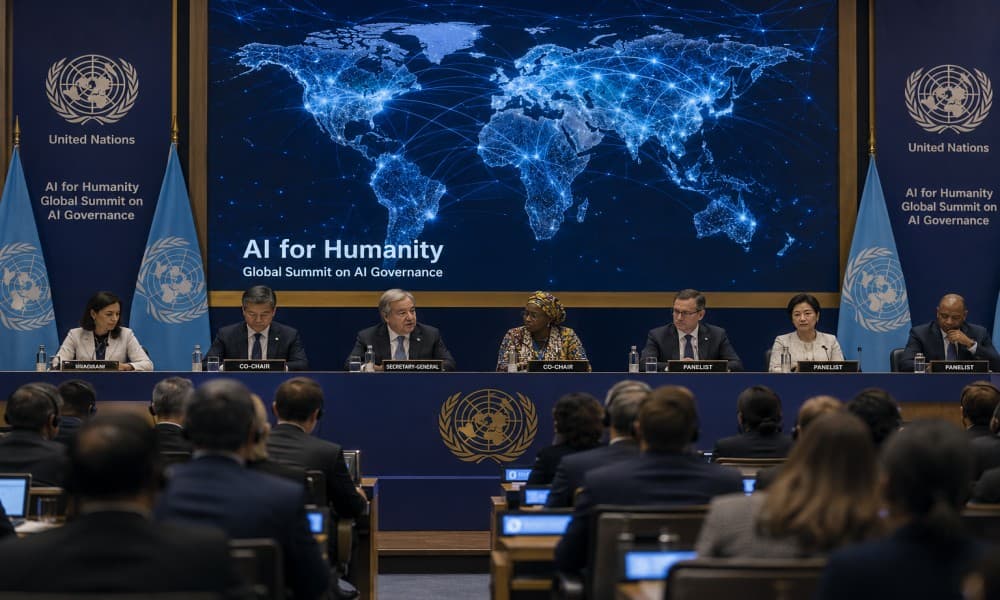
At a press conference, co-chair Maria Ressa highlighted that the rapid advancement of AI is continuing, with increasing power concentration and uncertain control. This report was released just ahead of the UN's first global dialogue on AI governance.
Likewise, the preliminary report serves as a toolkit for UN member states, providing broad guidance on harnessing AI's growth potential while addressing associated risks. It recommends developing local AI infrastructure, enhancing AI literacy, investing in developers, establishing AI safety institutes, combating disinformation, and monitoring AI systems in real-world settings.
Globally, access to AI varies, with over a billion users weekly; however, adoption lags in the global south compared to the global north. The US and China lead in developing advanced AI models and investing in the necessary compute infrastructure.

UN Calls for Stronger National AI Oversight
The report warns that the concentration of AI capabilities among few firms and countries may facilitate authoritarian control and weaken democratic accountability.
Moreover, the panel recommends that countries needing to catch up in AI development should invest heavily in computing and data infrastructure, underlining the necessity of a stable energy supply and datacenter construction.
Meanwhile, they recognise the environmental impacts of datacenters, such as high energy and water use and possible greenhouse gas emissions. Additionally, the report highlights difficulties in assessing safety and overseeing more advanced AI models.
Most countries, including advanced economies, lack the expertise to evaluate leading ‘frontier’ models or engage in their governance. A panel of 40 scientific experts describes the report as unprecedented, with the UN positioned as the primary global forum for addressing significant transboundary risks through a scientific approach. Additionally, disparities in language and internet access exacerbate the digital divide.
AI Gaps Jeopardise Global Safety
Artificial intelligence tools excel in English and other major languages, but many languages are either overlooked or perform poorly. This can lead to critical issues, especially in healthcare; for instance, a machine translation of Tigrinya inaccurately translated “smallpox” as “syphilis” and “you have been given intravenous antibiotics” as “you have been given intravenous insecticides.” Such mistranslations pose serious risks to patient safety.
Some regions struggle with stable internet access and AI adoption, with over 2 billion people offline globally. At a recent press conference, journalists questioned the independent panel for not exerting more pressure for country commitments and for not recommending an international body to assess powerful AI models prior to public release.
Further, the panel stressed that their report aims to present factual information rather than policy recommendations, concerned that excessive recommendations might politicise their work and compromise its scientific integrity, as stated by Ressa.
Ultimately, Ressa noted that while it may seem like a missed opportunity not to make policy recommendations, the insights provided by scientists are what truly matter. These insights are applicable in various cities, including Washington, Beijing, and Manila, with decisions expected to be made in Geneva the following week, where states will convene.